Senior cat constipation can be worrying, especially if your older cat keeps visiting the litter tray, strains, or produces little or no poo. It can also be confusing because hairballs usually show up differently, through gagging, retching, or vomiting. This guide explains what to note, how constipation and hairballs can look different, and when to speak to your vet.
Disclaimer: This article is for educational purposes only and is not a substitute for professional veterinary advice. Speak to your vet promptly if your cat repeatedly strains, produces little or no poo, stops eating, vomits or seems uncomfortable. Seek urgent veterinary advice if you are unsure whether your cat is trying to pass poo or urine, or they appear weak, distressed or very unwell.
Key takeaway: Repeated litter tray visits, straining and small, hard stools can be associated with constipation. Gagging or retching away from the tray is more consistent with a hairball-type pattern, but repeated coughing, retching or vomiting should not automatically be assumed to be a hairball. Straining to pass urine can look similar to straining to poo and may need urgent veterinary attention.
Quick answer: senior cat constipation and litter tray straining
Repeated trips to the litter tray, prolonged straining and small, hard or absent stools may suggest constipation. Hairballs more often involve gagging, retching or vomiting away from the litter tray.
Straining to poo and straining to urinate can look very similar. Check whether your cat is passing normal urine, but do not delay veterinary advice if you are unsure, particularly when little or nothing is being produced.
Senior cat constipation vs hairballs: quick comparison
| What you are seeing | More consistent with constipation | More consistent with a hairball-type pattern |
|---|---|---|
| Repeated litter tray visits with little or no poo | Yes | No |
| Straining or remaining in the tray longer than usual | Yes | No |
| Small, hard or dry stools | Yes | No |
| Gagging or retching away from the litter tray | No | Yes |
| Vomit containing hair | No | Yes |
| Reduced appetite or energy | Can happen | Can happen |
| Repeated coughing, retching or vomiting | Needs veterinary advice | Needs veterinary advice |
This comparison cannot confirm the cause. Repeated straining, vomiting, coughing or unproductive retching should be discussed with your vet.
A quick note on senior cats: it’s the change that matters
Some older cats do poo a little less often than they used to. What matters is a change from your cat’s normal pattern, especially if it comes with discomfort or behaviour changes.
If you’re thinking “my cat’s routine has changed and they seem uncomfortable,” that’s enough to take it seriously.
If you’ve also noticed weight dropping (or you’re unsure whether it’s a real trend), see Senior cat weight loss for what to track and when to speak to your vet.
What to note if your senior cat is straining in the litter tray
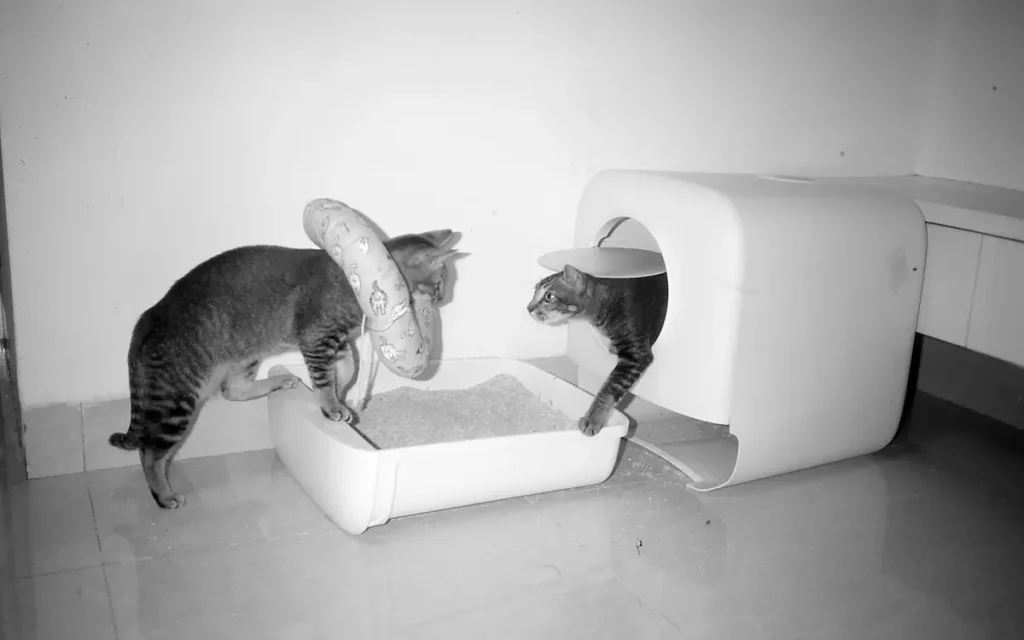
This isn’t about trying to fix constipation at home. It’s about gathering a few simple facts so you can explain the pattern clearly if you need to speak to your vet.
1) What is happening in the tray?
Try to note:
- When you last saw a normal poo
- Whether your cat is producing anything at all
- Whether the stools are small, hard, dry, or different from normal
- Whether there is any diarrhoea or soft stool
- Whether your cat is straining once or repeatedly returning to the tray
- Whether your cat cries, sits for longer than usual, or seems unsettled afterwards
2) Are you sure it is poo and not wee?
This is an important point. From a distance, straining to poo and straining to wee can look similar.
Try to check:
- Is there normal urine in the tray?
- Are there smaller or larger wee clumps than usual?
- Is your cat visiting the tray often but producing very little?
- Are there accidents outside the tray?
- Does your cat seem distressed while trying?
Straining to urinate can look very similar to straining to poo. If your cat repeatedly visits the tray, produces little or no urine, seems distressed, or you cannot tell which they are trying to pass, seek urgent veterinary advice.
Our Senior Cat Straining to Pee guide explains the urinary signs that need prompt attention.
3) What else has changed?
Also note anything that has changed around the same time, such as:
- Eating less
- Drinking more or less than usual
- Vomiting or repeated retching
- Hiding or being quieter
- Weight loss
- Reduced mobility
- Difficulty getting into the litter tray
- A recent change in food, litter, routine, or household stress
If getting into the tray seems harder than it used to, you may also find Best litter box for senior cats: easier access, less mess helpful for thinking about easier access and tray setup.
These details can help your vet understand the pattern and decide how promptly your cat needs to be examined.
When to speak to your vet
Speak to your vet promptly if your senior cat:
- repeatedly strains or returns to the litter tray
- produces very small, hard stools or no stool
- appears uncomfortable or cannot settle
- eats less or stops eating
- vomits or repeatedly retches
- becomes quieter, hides or behaves differently
- has a clear change from their usual toileting pattern
Seek urgent veterinary advice if:
- your cat appears distressed, weak or very unwell
- they collapse or have markedly reduced energy
- straining happens alongside repeated vomiting
- they repeatedly visit the tray but produce little or no urine
- you cannot tell whether they are straining to poo or urinate
You do not need to identify the cause before contacting your vet. Describe what is happening in the tray, what has been produced and any changes in appetite, vomiting, energy or behaviour.
For a broader overview of changes owners may notice in older cats, see our Senior Cat Health guide.
For wider guidance on age-related pooing, urination and litter tray changes, see our Senior Cat Toileting Changes guide.
Final thoughts
Senior cat constipation may involve repeated litter tray visits, difficult straining and small, hard or absent stools. Hairball-type episodes are more often associated with gagging, retching or vomiting away from the tray.
The most important safety distinction is whether your cat is trying to pass poo or urine. Speak to your vet promptly when straining continues, little or nothing is produced, or your cat seems uncomfortable. Seek urgent advice when you cannot tell whether the problem is bowel or urinary.
FAQs
How long is “too long” for a senior cat not to poo?
There isn’t one perfect number because routines vary. A good rule is: if it’s unusual for your cat, or you’re seeing straining or discomfort, it’s worth mentioning sooner rather than later.
Can hairballs cause constipation?
Hairballs usually cause stomach or throat signs (retching or vomiting). Cornell Feline Health Center notes that a large hairball can sometimes cause a blockage, which is one reason repeated unproductive retching or ongoing vomiting is worth discussing with your vet.
My cat is straining — how do I tell if it’s poo or wee?
If you’re unsure, assume it’s important. Straining and frequent trips with little produced can look similar, and it’s safer to speak to your vet urgently than to guess.
My cat keeps gagging but nothing comes up — is that a hairball?
Cornell Feline Health Center notes that repeated, unproductive retching can be a warning sign, so it’s sensible not to wait too long — especially in older cats.
External references
- International Cat Care (ISFM) — Constipation in cats
- Cornell Feline Health Center — The Danger of Hairballs