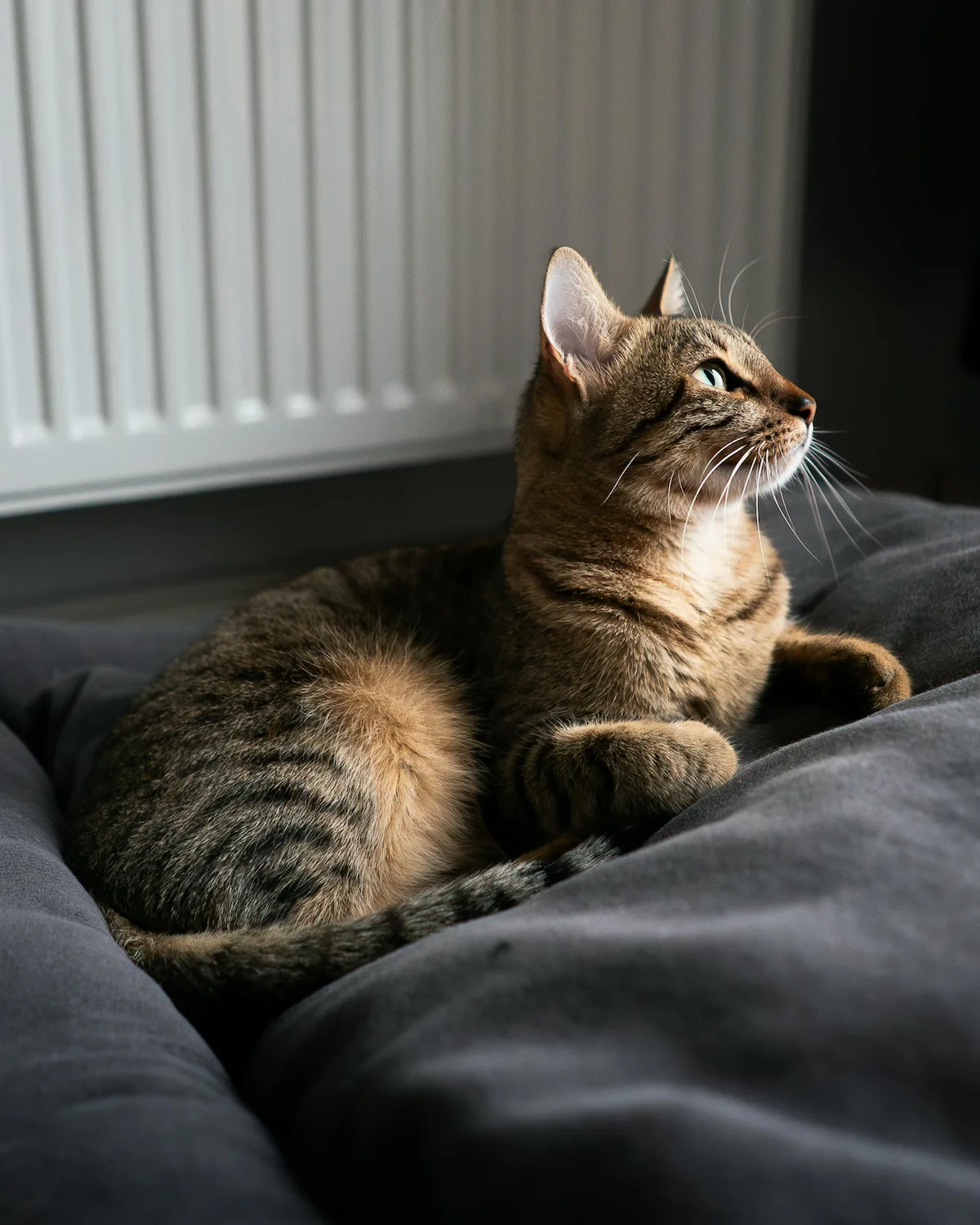
If your senior cat seems more unsettled after something changes at home, it can be hard to know what you are looking at. Older cats often rely more heavily on routine, familiar spaces, and easy access to the things they use every day, so changes that once seemed manageable may feel bigger now. Cornell notes that older cats can become more sensitive to household change because adapting to unfamiliar situations tends to get harder with age.
Disclaimer: This article is for educational purposes only and is not a substitute for professional veterinary advice. If your cat is in pain, losing weight, vomiting frequently, or acting differently, speak to your vet.
Key takeaway: Senior cat stress often shows up when routine, access, noise, or familiar spaces change. Gentle home adjustments can help, but a clear or ongoing behaviour change is still worth mentioning to your vet.
Quick answer: senior cat stress
Senior cat stress can show up when an older cat’s routine, resting places, access to essentials, noise levels, or familiar spaces change. Some cats may hide more, vocalise differently, eat less, avoid busy rooms, or seem less settled than usual.
Gentle home changes may help, such as keeping routines predictable, protecting quiet resting places, and making food, water, litter trays and beds easy to reach. If the change is new, ongoing, worsening, or linked with appetite, toileting, mobility, pain or behaviour changes, speak to your vet.
Why older cats can find change harder
Many older cats become more dependent on predictability. They may prefer the same sleeping spots, the same quiet parts of the house, and the same easy routes between food, water, litter, and rest. That does not mean every senior cat dislikes change. It does mean that some become less adaptable when the home feels less familiar. Cornell’s senior-cat guidance makes this point clearly: household change can affect older cats more because their ability to adjust to unfamiliar situations often diminishes with age.
It is also sensible not to assume stress is always the whole explanation. In older cats, pain, stiffness, reduced confidence, or other age-related changes can sit behind behaviour that first looks like “stress”. Cornell specifically notes that behaviour changes in senior cats should not simply be dismissed as old age, and also points out that conditions such as arthritis can affect access to things like the litter tray.
For broader context on age-related health and behaviour changes, see Senior Cat Health: A Practical Guide for Older Cats.
Common home changes that can unsettle a senior cat
Some changes are obvious, such as moving house or bringing in another pet. Others seem minor to us but can still disrupt an older cat’s sense of security.
Cats Protection lists common stress triggers in cats such as moving home, building work, guests, and poorly placed essentials like food bowls or litter trays.
Furniture moves, decorating, and blocked familiar routes
A changed room layout, a favourite chair disappearing, or a hallway full of boxes can make the home feel less predictable. Some older cats become cautious when their usual pathways, sightlines, or resting places no longer feel the same.
Visitors, noise, and busier rooms
Guests, louder evenings, children visiting, or work being done in the home can all make a senior cat withdraw sooner than they used to. A cat that once tolerated bustle may now need more distance from it.
Changes to feeding spots, water, litter trays, or beds
Even helpful changes can be unsettling if food, water, litter, or favourite beds are moved all at once. For older cats, the problem is not only that things have changed. It is also that the new setup may feel less familiar or harder to reach.
New people, pets, or altered routines
A new pet, a partner moving in, changed work hours, more time away from home, or a different evening routine can all affect how settled an older cat feels. Cats are often sensitive to changes in behaviour patterns and routines, and stress signs may show up through everyday patterns rather than in one dramatic event.
Gentle ways to reduce change at home
These simple steps can help reduce senior cat stress by making the home feel more predictable again.
The aim is not to make the house perfect. It is to make daily life feel steady, predictable, and easy to navigate again.
Keep the routine as steady as possible
Try to keep feeding times, quiet times, and normal room access as consistent as you can. Routine often matters more to older cats than owners realise, especially during a disruptive week.
Protect familiar resting places
Make sure your cat still has access to one or two quiet spots they already know well. These spaces should be calm, easy to reach, and left alone as much as possible.
Avoid changing everything at once
If you need to move things around, try not to change food, water, litter, and bed locations all in the same few days. Keeping some anchors in place can help the home feel less unsettled.
Make access easy
Think about whether your cat can still reach the places they use most without climbing, squeezing past clutter, or crossing noisy areas. Older cats often cope better when everyday tasks require less effort.
Introduce unavoidable changes gradually
Some disruption cannot be avoided. If you are decorating, rearranging furniture, or expecting guests, it often helps to keep one area of the home as familiar as possible while the rest changes around it.
Give your cat space without withdrawing comfort
A stressed older cat often benefits from choice. Stay gentle and predictable, but do not force interaction if your cat is clearly choosing distance or quiet.
Signs stress may be affecting your older cat
Stress in cats is not always obvious. The signs can be subtle and may affect patterns of behaviour and routine, such as eating, grooming, toileting, social behaviour, or activity.
You might notice that your older cat is:
- hiding more
- spending less time in busy rooms
- seeming clingier or less settled
- vocalising differently
- eating less
- sleeping in unusual places
- showing litter tray changes
- behaving unlike themselves in small but noticeable ways
That does not prove stress is the cause. It does, however, give you useful patterns to watch.
If stress seems part of a wider change in sleep, vocalising, confidence, clinginess, hiding or routine, our Senior Cat Behaviour Changes guide may help you look at the bigger pattern.
If hiding has become part of the pattern, see Older cat hiding: common reasons and when it’s worth mentioning.
If your cat has also started peeing outside the litter tray, see Senior cat peeing outside the litter tray: what to check and when to speak to your vet.
When stress may not be the whole story
It is worth pausing when the pattern is becoming clearer rather than settling down.
Stress may not be the only factor if your cat is also:
- eating less
- drinking differently
- avoiding the litter tray
- seeming stiff or less willing to jump
- vocalising more than usual
- sleeping in odd places because usual spots are harder to reach
- seeming withdrawn, confused, or unlike themselves
Cornell’s senior-cat guidance reinforces two important points: older cats may be more sensitive to change, but behaviour changes should not be brushed off as simple ageing.
When to speak to your vet
It is worth speaking to your vet if the change is new, obvious, ongoing, or paired with appetite changes, litter tray changes, signs of discomfort, or a broader change in how your cat seems day to day. In older cats, it is sensible to treat a clear behaviour change as something worth noticing rather than something to explain away too quickly. Cornell specifically advises against writing off these kinds of changes as “just old age”.
A good rule of thumb is this: gentle home adjustments are reasonable first steps, but they should not be used to explain away a pattern that keeps building.
FAQs
Can changes at home stress a senior cat?
Yes. Older cats can become more sensitive to unfamiliar situations and routine changes than they were when younger. Cornell notes that older cats may react more to household change because adapting to it becomes harder with age.
Why is my older cat hiding after furniture was moved?
Hiding can be one way a cat responds when the home feels less predictable or less secure. A changed layout, different smells, extra noise, or blocked favourite routes can all contribute.
Do older cats cope worse with routine changes?
Many do. Cornell’s senior-cat guidance supports this directly, and stress in cats can often show up through changes in routine and behaviour patterns.
How can I help a stressed senior cat at home?
The safest starting points are a steadier routine, quiet resting spaces, easy access to essentials, and avoiding too many changes at once. Keep things familiar where you can, and make new changes gradually.
When is stress in a senior cat worth mentioning to your vet?
It is worth mentioning when the change is clear, ongoing, or paired with appetite, litter tray, mobility, or other behaviour changes. In older cats, behaviour shifts should not simply be put down to age.
Wrap-up
Senior cat stress is often less about one dramatic event and more about how predictable, quiet, and easy daily life feels. In many homes, senior cat stress starts to ease when routines, resting spots, and key resources stay steady.
Older cats can be more affected by routine shifts, noise, moved resources, and changes in the home than they were when younger. Gentle home adjustments may help, but if the pattern is new, keeps happening, or comes with other changes, it is sensible to speak to your vet.