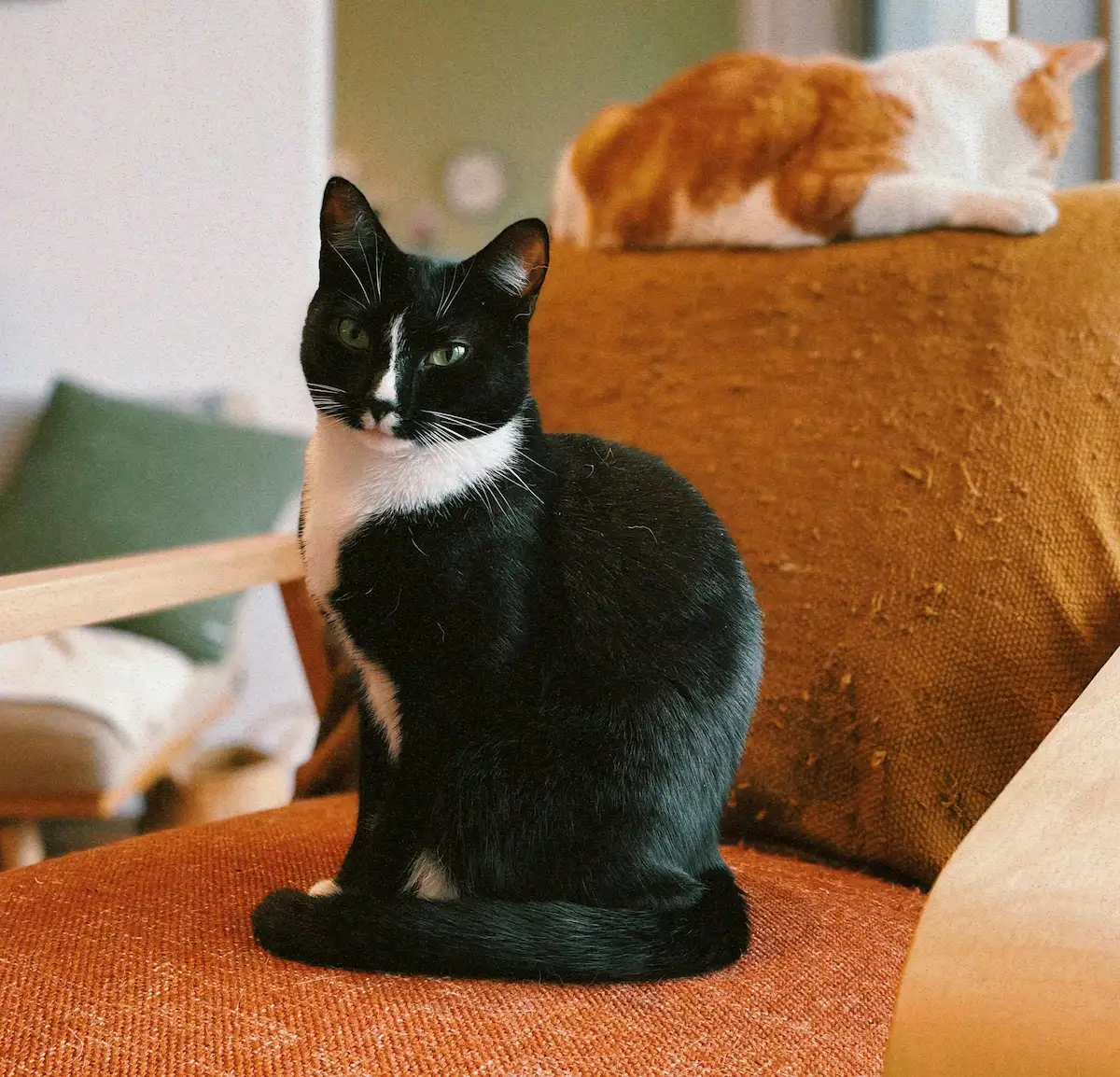
Bringing a new cat home can be exciting, but it can also feel unsettling for an older cat who already has a familiar routine. Introducing a new cat to a senior cat usually works best when you move slowly, protect your older cat’s usual spaces, and give both cats time to adjust without pressure.
Disclaimer: This article is for educational purposes only and is not a substitute for professional veterinary advice. Speak to your vet if your senior cat persistently hides, eats less, loses weight, toilets differently, seems painful or stiff, becomes unusually withdrawn or shows a marked change in behaviour.
Key takeaway: Introducing a new cat to a senior cat usually works best through separate spaces, scent swapping, brief barrier contact and short supervised meetings. Protect your older cat’s routine and resources, and only progress when both cats can remain settled and move away freely.
Quick answer: introducing a new cat to a senior cat
Keep the cats in separate spaces at first. Let them become familiar with each other’s scent before allowing brief visual contact through a secure barrier.
Protect your senior cat’s normal feeding area, litter tray, resting places and escape routes. Progress to supervised meetings only when both cats appear settled, and return to an earlier step if either cat starts hiding, blocking, chasing or avoiding normal routines.
Can a senior cat accept a new cat?
Many senior cats can learn to live with a new cat. Some may become companions, while others may simply share the home peacefully.
Calm coexistence is a successful outcome. The aim is not to force friendship but to help both cats feel safe, use their resources and rest without pressure.
A senior cat who has lived alone for years or prefers a quiet routine may need longer to adjust. Progress should be based on how both cats are coping rather than a fixed timetable.
Why older cats often need a slower introduction
Older cats often value routine. They may have favourite sleeping places, feeding areas, sunny spots, and paths through the home. A new cat can disrupt all of that very quickly.
A senior cat may also be less tolerant of:
- Sudden movement
- Chasing
- Noisy play
- Doorway blocking
- Sharing food or litter areas
- Having another cat approach while they are resting
Some older cats also have reduced mobility, stiffness, weaker senses, or lower confidence. This can make it harder for them to move away quickly if a younger or more energetic cat approaches.
For broader guidance on helping an older cat cope with household change, see our Senior Cat Stress guide.
Cat welfare organisations such as International Cat Care and Cats Protection recommend slow, careful introductions rather than rushing cats into direct contact too soon.
Before introducing a new cat to a senior cat: protect your older cat’s routine
Before the new cat comes home, think about your senior cat first.
Try not to move your older cat’s important resources unless you really need to. Their normal feeding area, water bowl, litter tray, bed, scratching place, and resting spots should stay as familiar as possible.
The new cat should have their own separate space at first. This could be a quiet spare room or another safe area where they have everything they need.
Set up the new cat’s room with:
- Food and water
- A litter tray
- A bed or blanket
- Hiding places
- A scratching option
- Toys
- A comfortable place to rest
This helps the new cat settle in without immediately entering your senior cat’s main territory.
It also gives your older cat time to notice the change through sound and scent before any face-to-face meeting happens.
The new cat should not immediately have access to the senior cat’s safest, most familiar spaces.
The aim is to prevent the new arrival from controlling access to anything your senior cat relies on, including food, water, litter trays, beds and routes through the home.
Step 1: Keep the cats separate at first
When the new cat arrives, do not place both cats together straight away.
Keep the new cat in their own room and allow your senior cat to continue using their normal areas. At this stage, both cats may hear and smell each other through the door, but they should not have direct contact.
Avoid:
- Holding one cat up to the other
- Opening the door “just to see what happens”
- Letting them sort it out themselves
- Forcing either cat to approach
- Moving the senior cat out of their usual spaces
Your senior cat may sniff around the door, walk away, ignore it, or seem cautious. That is normal. Give them time.
Step 2: Use scent before sight
Cats rely heavily on scent, so scent swapping can be a useful early step.
You can gently swap items such as:
- A soft cloth
- A blanket
- Bedding
- A toy
- A towel the cat has rested on
Place the item nearby and let your cat choose whether to investigate it. Do not push it towards their face or force them to sniff it.
If your senior cat sniffs the item and walks away, that is still information. If they seem relaxed, you can repeat this over several short sessions.
If they hiss, avoid the item, or seem unsettled, slow down. Give them more time before trying again.
Step 3: Allow brief visual contact through a barrier
Once both cats seem calmer with scent, you can allow brief visual contact through a safe barrier.
This might be:
- A securely fitted baby gate
- A screen door
- Another secure barrier that allows sight without direct contact
Keep these sessions short. A few calm moments are better than a long session that ends with tension.
Your senior cat should always be able to leave. Do not block their path, hold them in place, or place them too close to the barrier.
At this stage, you are simply helping the cats learn:
“There is another cat here, but nothing bad is happening.”
Signs that a cat is coping include being able to look away, eat, explore or leave the area. Prolonged freezing, repeated growling, charging the barrier or refusing to use nearby rooms suggests that more distance or time is needed.
Step 4: Try short, supervised meetings
Only move to direct meetings when both cats seem reasonably calm with scent and sight.
The first meetings should be short and supervised. Keep the atmosphere quiet. Avoid lots of visitors, loud noise, or excited handling.
During early meetings:
- Keep doors open so the senior cat can leave
- Stay nearby but calm
- Do not pick up either cat to force contact
- Do not let one cat chase or corner the other
- End the session before tension builds
Brief hissing or cautious behaviour does not necessarily mean the introduction has failed. Give both cats enough space to move away.
Pause the meeting if there is repeated chasing, blocking, swatting or growling, or if either cat freezes, hides or cannot leave comfortably.
Step 5: Build up time gradually
If both cats remain settled during short meetings, gradually increase the time they spend together.
Progress means that both cats can move around, eat, rest and use their resources without being chased, blocked or watched constantly.
Move at the pace of the least comfortable cat. Returning to scent swapping, barrier contact or shorter meetings is not failure; it is a sensible response when either cat needs more space.
Introducing a kitten to an older cat
Introducing a kitten to an older cat needs extra care.
Kittens can be playful, fast, noisy, and persistent. A senior cat may not want constant attention, even from a friendly kitten.
A kitten may be excited to play. Your older cat may simply want to sleep.
That does not mean either cat is doing anything wrong. They are just at different life stages.
To make things easier:
- Give the kitten separate play sessions
- Do not expect your senior cat to entertain the kitten
- Make sure your older cat has kitten-free resting areas
- Protect your senior cat’s usual sleeping spots
- If the kitten keeps chasing, calmly separate them and give the kitten another play outlet
- Keep early contact short
A friendly kitten can still be tiring or intrusive for an older cat, so separate play and kitten-free resting areas remain important.
How to set up the home for two cats
Separate resources reduce competition and make it harder for one cat to control access. Both cats should be able to reach food, water, litter trays, beds and safe routes without having to pass or confront the other.
Food and water
At first, feed the cats separately.
Your senior cat should not feel that the new cat can rush towards their bowl or push them away. If your older cat starts eating less, leaving food, or avoiding their usual feeding area, slow the introduction down and check whether the new cat is creating pressure around mealtimes.
Keep water available in more than one place too.
Litter trays
Do not remove your senior cat’s usual litter tray when the new cat arrives.
It is usually better to provide extra trays, especially while the cats are adjusting. Your older cat should not have to pass the new cat or enter a tense area just to toilet.
If your older cat needs a tray with easier access, see our Best Litter Box for Senior Cats guide.
Resting spots
Senior cats need quiet places where they can properly rest.
Offer several comfortable options, such as:
- A familiar bed
- A blanket on the sofa
- A quiet room
- A low resting spot
- A warm, draught-free area
- A raised spot only if your cat can access it safely
For more help creating quiet, comfortable places where your older cat can rest undisturbed, see our Senior Cat Resting Spots guide.
Escape routes
Your senior cat should be able to move away without being trapped.
Watch for areas where one cat could block the other, such as:
- Doorways
- Hallways
- Stairs
- Litter tray entrances
- Food areas
- Favourite sleeping spots
If the new cat keeps blocking routes or following your senior cat, separate them and return to shorter, calmer sessions.
Signs the introduction may be going too fast
A senior cat may not always show stress dramatically. Sometimes the signs are subtle.
The introduction may be moving too quickly if your senior cat:
- Hides more than usual
- Avoids rooms they normally use
- Eats less
- Sleeps in unusual places
- Stops using favourite resting spots
- Watches doorways or corners constantly
- Growls, hisses, swats, or chases repeatedly
- Seems restless or unsettled
- Grooms much more or much less than usual
- Toilets differently
These signs do not always mean the new cat is the only cause. In senior cats, changes in appetite, toileting, movement, grooming, or confidence can also be linked with health or pain.
If changes are persistent, sudden, or worrying, speak to your vet.
For help assessing wider changes, see our Senior Cat Behaviour Changes guide.
When to pause and go back a step
Pausing is not failure. It is often the kindest next step.
Go back to separation, scent swapping, or barrier contact if:
- Meetings are getting worse rather than better
- One cat repeatedly chases the other
- The new cat blocks food, water, litter, or doorways
- Your senior cat cannot rest normally
- Either cat seems frightened rather than cautious
- Your older cat avoids normal routines
- Conflict happens around resources
Pause before chasing, blocking or fear becomes an established pattern. Return to the last stage where both cats could remain settled.
When to speak to your vet or a qualified behaviour professional
If your senior cat develops persistent changes in appetite, weight, toileting, mobility or behaviour during the introduction, speak to your vet. Older cats can have health changes that may look like stress, so do not assume every new behaviour is caused by the new cat.
If health concerns have been ruled out but repeated chasing, blocking or fear continues despite slowing the introduction down, a qualified feline behaviour professional may be able to help with a structured plan.
Final thoughts
Introducing a new cat to a senior cat should be guided by behaviour rather than a deadline. Protect your older cat’s routine, resources, resting places and ability to retreat.
Aim for calm coexistence first. Progress only while both cats can eat, rest, move away and use the home without pressure. Return to an earlier step if chasing, blocking, hiding or disruption to normal routines develops.
Speak to your vet when persistent appetite, weight, toileting, mobility or behaviour changes appear during the introduction.
For more help with calm home setup, quiet resting areas and daily comfort, see our Senior Cat Comfort & Lifestyle guide.
FAQs
How long does it take to introduce a new cat to a senior cat?
There is no fixed timeline. Some cats adjust in days or weeks, while others need longer. Senior cats often benefit from a slower pace, especially if they are used to living alone or have a very settled routine.
Move forward only when both cats seem calm. If either cat becomes tense, frightened, or unsettled, go back a step.
Should I let my senior cat and new cat meet straight away?
Usually, no. A direct first meeting can feel overwhelming for both cats, especially if your senior cat is used to a quiet home.
Start with separate spaces, then scent swapping, then brief visual contact through a barrier. Full meetings should come later, when both cats seem calmer.
What if my senior cat hisses at the new cat?
Occasional hissing can be a sign that your senior cat is unsure or setting a boundary. Do not punish them for this.
Instead, give more space and slow the introduction down. If hissing escalates into repeated chasing, blocking, swatting, or distress, pause the process and return to an earlier step.
Is it fair to get a kitten when I have an older cat?
It can work, but it needs care. Kittens are often energetic and may want more play than a senior cat can comfortably handle.
Your older cat should have quiet areas, safe escape routes, and kitten-free resting spaces. The kitten should have separate play sessions so they are not relying on your senior cat for entertainment.
Can a senior cat and a new cat become friends?
Yes, some senior cats do become friendly with a new cat. Others simply learn to live together peacefully.
Both outcomes can be successful. The most important goal is that both cats feel safe, can use their resources, and can relax in the home.
External references
- International Cat Care: Introducing cats
- Cats Protection: Getting another cat