Small, sensible home changes can make daily life easier for an older cat — especially around walking routes, slippery floors, resting spots, litter tray access and big jumps. This senior cat comfort guide explains practical ways to make your home calmer, easier to move around and more supportive without changing everything at once.
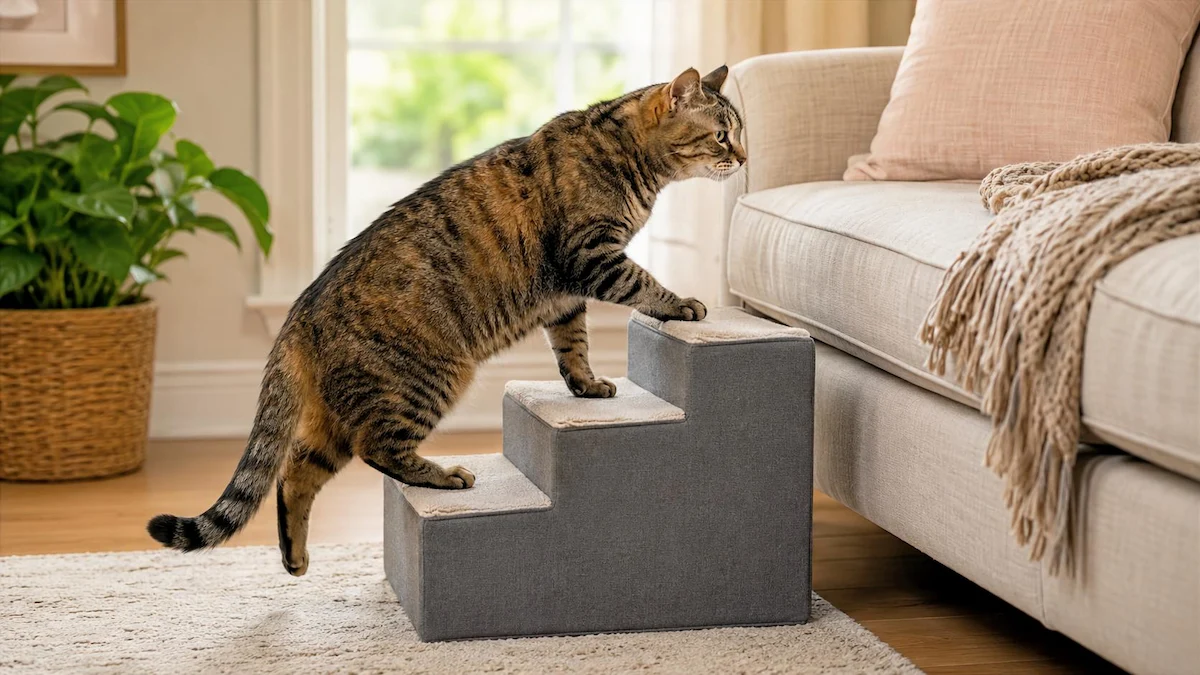
Cat stairs for older cats may help when a cat still wants to reach a bed, sofa or windowsill but repeated big jumps have become harder or less confident. Some cats manage small, steady steps well, while others may find a stable ramp or a lower resting place easier.
For a broader overview of senior cat care and day-to-day support, see our Senior Cat Care Guide.
Disclaimer: This article is for educational purposes only and is not a substitute for professional veterinary advice. Speak to your vet if your cat’s movement changes suddenly, they appear painful or weak, repeatedly slip or fall, or stop using normal routes or the litter tray.
Key takeaway: A senior-cat friendly home is not about changing everything at once. Start by reducing the biggest strain points: slippery routes, awkward jumps, hard-to-reach litter trays, uncomfortable resting spots and favourite places your cat still tries to reach.
Quick answer: are cat stairs good for older cats?
Cat stairs for older cats can help reduce one large jump when a cat can still manage small, steady step-ups. Look for steps that are stable, wide enough, non-slip and positioned where your cat already approaches the bed, sofa or windowsill.
A ramp or lower resting place may suit a cat who seems hesitant, stiff or less steady on separate steps. Speak to your vet if the change in movement is sudden, appears painful or affects normal walking, jumping or litter tray use.
Start with a 2-minute home audit: the daily route
Before you change anything, walk your cat’s most common route.
- Resting spot → litter tray
- Litter tray → food and water
- Food and water → favourite perch
- Favourite perch → resting spot
Look for:
- Slippery stretches, such as wood, laminate, tile or stairs
- “Must-jump” moments, such as a bed, sofa or windowsill with no safe route
- Long distances between essentials
- Tight corners or clutter that force awkward movement
- Noisy or busy locations, especially around the litter tray
This quick audit tells you exactly where a senior-cat friendly home needs help.
Senior cat comfort usually starts with the routes and places your cat already uses every day, rather than a complete home makeover.
Senior cat comfort and lifestyle topics covered
Small home changes can support an older cat’s confidence, comfort and daily routine. The most useful changes are usually the ones that reduce repeated strain, make essentials easier to reach, and help your cat feel settled in the places they already use.
| If you are noticing this | Start here |
|---|---|
| Your cat is finding beds, sofas or windowsills harder to reach | See the cat stairs section below |
| Your cat needs softer, easier resting places | Senior cat resting spots |
| Your cat seems less steady on floors | Non-slip flooring for senior cats |
| Your cat needs gentler play or mental stimulation | Senior cat play |
| The litter tray is becoming harder to use | Best litter box for senior cats |
| Toileting habits have changed | Senior Cat Toileting Changes |
| Movement, jumping or stiffness has changed | Senior Cat Mobility & Pain |
| Grooming is becoming harder | Senior cat grooming |
| Another pet is affecting your older cat’s routine | Introducing a New Cat to a Senior Cat |
Senior cat mobility: where home layout can reduce strain
Senior cat mobility often changes gradually. Your cat may still be able to walk, jump and climb, but certain parts of the home can start to feel more awkward than they used to.
The aim is not to stop your cat moving. Gentle movement is still part of normal daily life. The aim is to reduce unnecessary strain from repeated big jumps, slippery floors, long routes and awkward access to essential areas.
Focus first on the routes and access points your cat uses every day:
- The route from their resting spot to the litter tray
- The route to food and water
- The jump onto the sofa, bed or favourite perch
- Any stairs or slippery floors they cross often
- Narrow spaces where they have to twist, stretch or squeeze through
Small layout changes are usually enough to start with. A rug in the right place, a lower-entry tray, a stable step, or moving essentials closer together can make daily life feel easier without changing the whole home.
If your cat’s mobility changes suddenly, they seem painful, or they stop using normal routes altogether, it is sensible to speak to your vet rather than assuming it is just age.
Must-do changes: high impact, low fuss
1. Put essentials on the main living level
Older cats often do better when they do not have to travel far, or use stairs, just to meet basic needs.
Start with:
- Keeping food and water easy to reach, away from busy walkways
- Providing at least one litter tray in a quiet, easy-access area on the floor your cat uses most
- Considering a tray on each floor if your cat regularly uses more than one level of the home
Why it helps: less effort, fewer awkward climbs and fewer moments where your cat may avoid using the tray because it feels too far away or difficult to reach.
2. Create non-slip routes between key areas
Slips can make older cats hesitant and less willing to move around.
Simple fixes include:
- Adding rugs or runners on the main paths between resting areas, litter trays and bowls
- Making sure rugs do not slide
- Using a non-slip underlay if needed
- Keeping routes clear of clutter and trailing cables
International Cat Care’s home modification guidance recommends improving traction and adapting the home environment for older cats.
3. Make the litter tray easy to enter and easy to reach
A tray that is awkward to step into, or placed somewhere stressful, can become a common friction point for older cats.
Home-friendly adjustments include:
- Using a tray with a lower entry
- Offering an easier-to-step-into option
- Placing the tray in a quiet, predictable spot
- Keeping the approach clear
- Avoiding noisy or high-traffic areas, such as near washing machines, busy doorways or tight corners
Why it helps: older cats often prefer “easy in, easy out” and may avoid trays that feel awkward, exposed or uncomfortable to use.
For a broader guide to age-related litter tray and toileting changes, see our Senior Cat Toileting Changes guide.
4. Add warm, quiet resting spots with easy access
Senior cats often appreciate:
- A draft-free spot
- A bed they can step into easily
- More than one resting option
- A calm place away from household traffic
If your cat sleeps in two different zones of the house, add a comfortable rest spot in each so they are not always commuting.
International Cat Care notes that older cats may benefit from soft beds in quiet, easily accessible places, with warmth and comfort taken into account.
For more detailed ideas, see our guide to senior cat resting spots.
Cat stairs for older cats: safer ways to reduce big jumps
Cat stairs for older cats are most useful when your cat has a favourite spot they still want to reach, but the jump has started to feel like more effort than it used to.
Many older cats still want their usual windowsill, sofa or bed — they just benefit from a safer way up.
Cornell Feline Health Center suggests practical home adjustments such as box steps, ramps or pet stairs so an older cat can reach favourite places more comfortably and independently.
Where stairs or steps help most
Start with the places your cat uses daily:
- The sofa
- The bed
- A favourite window or perch
- A regular lookout spot
Pick one or two locations, not every surface. That keeps the change manageable and lets you see what your cat actually uses.
A simple safety checklist for cat stairs
When setting up cat stairs, box steps or any step-up route, aim for:
- Stability: it should not wobble or slide when you press it with your hand
- Firm footing: the surface should feel secure under paws
- Gentle steps: avoid steep climbs or big gaps between steps
- Enough width: narrow stepping points can feel unsafe
- A clear landing: the top step should lead to a stable resting surface
International Cat Care notes that stairs and ramps should be covered with non-slip materials to reduce slipping. Cornell also highlights the value of firm footing so the cat is less likely to slip.
Cat stairs vs ramps for older cats
Cat stairs may suit older cats who can still step up comfortably but need help avoiding one large jump.
A ramp may be easier for a cat who seems stiff, hesitant, less steady, or unsure about separate steps.
Whichever option you choose, the most important features are stability, non-slip footing, a gentle angle or step height, and a clear landing at the top.
For more detailed guidance on choosing and positioning a ramp, see our Cat Ramps for Older Cats to Get on Bed guide.
If your cat’s movement has changed noticeably, or you are unsure whether stairs or a ramp are suitable, speak to your vet for advice.
Help your cat accept the new route without forcing it
Older cats can take time to trust a new setup.
Try to:
- Place steps where your cat already approaches the jump
- Keep the setup in the same position so your cat has time to investigate it without pressure
- Let your cat investigate in their own time
- Avoid lifting or pushing them onto the steps
- Make the route simpler if they seem unsure
If your cat will not use the stairs, the issue may be placement, steepness, surface texture or confidence. A wider step, gentler ramp or different position may work better.
Optional upgrades: only if they solve a real problem
Add gentle guidance at night
Some older cats feel less confident in the dark, especially if their eyesight is not as sharp as it once was.
A small nightlight near the route to the litter tray can help keep movement predictable and less stressful.
Add a second water station
If your cat spends most of the day in one area, such as upstairs or in a quiet room, an extra water bowl nearby can reduce unnecessary trips.
Keep bowls away from litter trays and busy walkways where possible.
Create calm “quiet corners”
Provide at least one place that is:
- Away from noisy foot traffic
- Away from doorways
- Easy to reach
- Set up with a simple, comfortable bed option
If the change at home involves another pet, our guide to introducing a new cat to a senior cat may help you take a slower approach.
Keep gentle play realistic
Some older cats still enjoy play, but may prefer shorter, softer sessions with less jumping and chasing.
Gentle play can support routine and confidence, but it should not be forced. If your cat walks away, seems stiff, or becomes irritated, stop and let them rest.
For more ideas, see Senior cat play: gentle enrichment ideas for older cats.
Common mistakes to avoid
Well-meant changes can sometimes make the home feel less predictable.
Try to avoid:
- Wobbly steps or ramps: if they shift under your hand, they may feel unsafe under your cat
- Too many changes at once: change one thing, then observe
- Removing all favourite high spots: instead, provide a safer route up where possible
- Strong-smelling cleaners around beds or trays: lingering scents can be off-putting to many cats
- Moving essentials too often: older cats often do better when the home layout stays predictable
When it’s worth speaking to a vet
Home changes can help with comfort, but they are not a replacement for veterinary advice.
It is worth speaking to your vet if you notice:
- A sudden change in jumping, climbing or walking
- Persistent litter tray avoidance, especially if new
- Hiding more than usual
- Unusual irritability
- Changes in appetite, thirst or weight
- Difficulty grooming
- Anything that feels out of character for your cat
If you are unsure whether a change is age-related or something worth checking, our Senior Cat Health guide explains common changes and when to speak to a vet.
Use this checklist as a starting point, then follow the links above for more detailed help with resting spots, flooring, litter tray access, play, grooming and mobility support.
Think of senior cat comfort as a series of small adjustments: easier routes, safer footing, calmer resting places and essentials that are simple to reach.
Quick checklist: senior-cat friendly home essentials
- Essentials such as food, water and litter are easy to reach on the main living level
- Non-slip routes exist between rest areas, trays and bowls
- The litter tray is quiet, accessible and easy to step into
- Warm, calm resting spots are available in the main areas your cat uses
- Cat stairs for older cats are set up for one or two favourite places
- Steps or ramps are stable and non-slip with a clear landing
- The layout stays consistent where possible
- Night-time routes, especially to the tray, are easy to navigate
- Play is gentle and does not rely on big jumps
- Grooming, movement or behaviour changes are mentioned to your vet if they are new, sudden or worrying
FAQs
Do older cats need cat stairs?
Not always. Cat stairs are most helpful when your cat still wants to reach a favourite spot, such as a sofa, bed or windowsill, but big jumps look harder or less confident than before.
Where should I place cat stairs for older cats?
Start with one key location your cat uses every day, usually the bed, sofa or favourite perch. Place the steps where your cat already approaches the jump and keep the setup in the same position while they become familiar with it.
How do I know if cat stairs are safe?
They should feel stable, have non-slip footing, gentle step height and a clear landing at the top. If the steps wobble or slide when you press them with your hand, they are not ready.
What if my cat will not use the stairs?
Give it time. Make the route simpler, keep it in the same place and avoid forcing your cat onto the steps. Some cats prefer a ramp, wider steps or a different position.
Are ramps better than stairs for senior cats?
Sometimes. A ramp may suit a cat who seems less steady or unsure about separate steps. The best option depends on your cat’s confidence, movement and the space available.
When is it worth speaking to a vet about mobility changes?
If there is a sudden change in jumping, walking, climbing or litter tray use, or anything feels out of character, it is worth mentioning to your vet — especially if the change persists.
Final thoughts
Senior cat comfort usually comes from small changes rather than a complete home makeover.
Start with the routes your cat already uses. Improve slippery areas, reduce repeated big jumps, keep essential resources easy to reach and provide warm, quiet resting places.
Cat stairs may help a cat who can still manage small step-ups, while a stable ramp or lower resting place may suit others better. The most useful setup is one your cat can approach, use and leave confidently without being forced.
External references
International Cat Care — Home modifications for cats
Cornell Feline Health Center — Loving Care for Older Cats